
Anthropic presented scenarios of AI impact on wages and employment
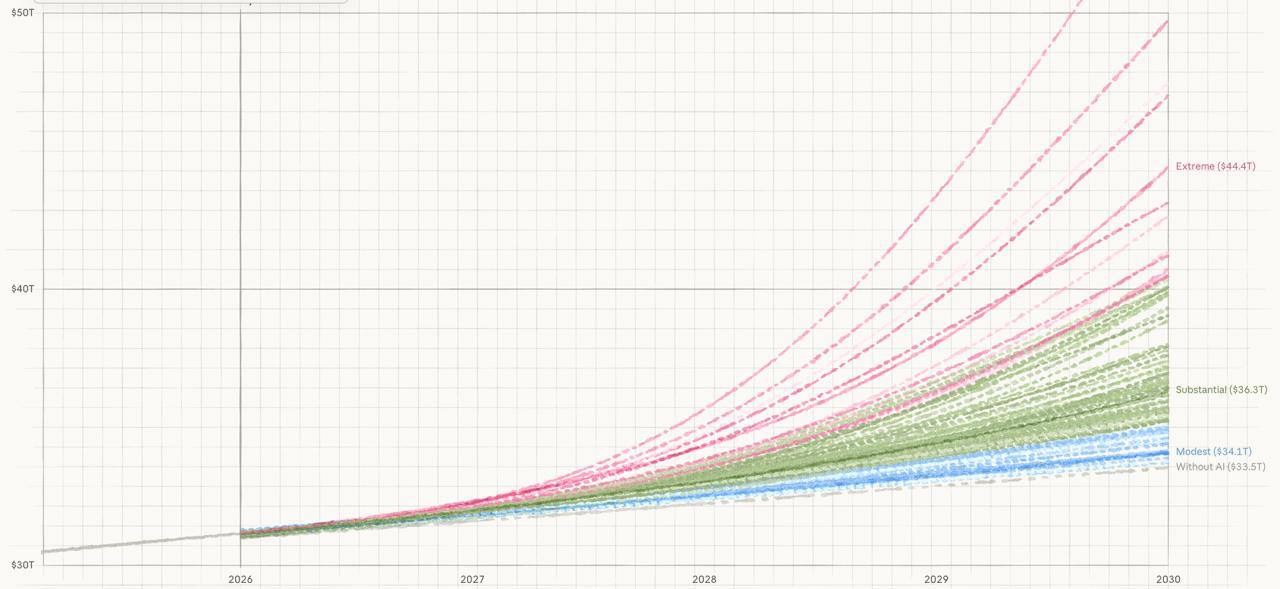
Anthropic economists have released an interactive model, “Scenarios for the Economic Future,” which shows how AI development might affect employment and wages in the US by 2030. The model is based on the technical report Economic Scenarios for Transformative AI (Korinek et al., 2026) and allows users to set their own expectations regarding AI capabilities and adoption scale to explore possible economic outcomes.
The authors identify three key scenarios. In the moderate scenario, the impact of AI is comparable to the effect of the internet: economic growth is noticeable but within historical norms, and wages remain roughly at the same level. In the substantial scenario, by 2030 AI can perform half of all mental work, the economy grows twice as fast as usual, but the incomes of knowledge workers do not increase. In the extreme scenario, AI surpasses humans in almost all tasks of mental labor and almost does not create new professions, which can lead to annual GDP growth of up to 15% and a doubling of the economy every 4.5 years.
However, such rapid growth is accompanied by serious imbalances in the labor market. In scenarios with strong automation, knowledge workers are hit: according to the authors’ estimate, developers and call center employees may need to move into professions less affected by AI, such as electricians or nurses. At the same time, changing professions is difficult, and in the extreme case unemployment could rise significantly.
Salaries also react unevenly. In the moderate scenario, incomes of knowledge workers barely grow, and in the extreme scenario, they fall by more than 10% by 2030. At the same time, the average salary in the economy may increase due to non-knowledge professions, demand for which grows thanks to productivity gains in other sectors.
The model highlights the change in income distribution: in the significant and extreme scenarios, labor’s share of GDP decreases while capital’s share increases. For example, in the extreme variant, workers receive only 45.2% of GDP instead of the current 60%, while capital owners receive 54.8%. This means that even with overall wealth growth, the benefits are distributed unevenly.
Importantly, the authors call their work scenarios rather than forecasts. They advise reading the most extreme version as a thought experiment, as it assumes recursive AI self-improvement and very rapid deployment, which is far from guaranteed. Moreover, the model does not account for policy measures, possible hyper-capable robotics, and other factors that could alter the outcome.
Anthropic emphasizes that the future is not predetermined and depends on how technologies develop and how society decides to distribute benefits. The company intends to use the model to develop policy initiatives aimed at broadly distributing the economic benefits of AI.
Primary source: www.anthropic.com ↗