
IT specialist outsourcing

AI-powered platform for sales conversion growth
Intelligent system for automating analysis of customer interactions that increases the efficiency of booking and sales departments, adapting to any industry for deep communication analysis and customer service improvement
Key problems we solve
Unstructured data
Calls and correspondence with clients remain chaotic. Valuable information is not systematized, which prevents building a unified picture of interactions.
Loss of information
Critical details of negotiations are forgotten or lost. Without a complete history of communication, managers miss key points, which leads to lost deals
Lack of failure analysis
In 90% of cases, customer rejections are not systematically analyzed. Managers do not receive objective data on the reasons potential customers leave, which prevents them from correcting mistakes.
Uneven quality of work
Different levels of manager training lead to unpredictable results. There is no unified work standard that would guarantee consistently high quality of service
Lost revenue
Potential clients go to competitors due to untimely response, lack of personalized approach, and unhandled objections
Industry blindness of analytical systems
Universal communication analysis systems ignore industry specifics, leading to superficial analysis and inaccurate recommendations
Limited scalability across different business processes
Narrowly specialized sales systems don't work in other departments. This forces businesses to use many disparate tools, leading to higher costs and lower efficiency
Unstructured data
Calls and correspondence with clients remain chaotic. Valuable information is not systematized, which prevents building a unified picture of interactions.
Loss of information
Critical details of negotiations are forgotten or lost. Without a complete history of communication, managers miss key points, which leads to lost deals
Lack of failure analysis
In 90% of cases, customer rejections are not systematically analyzed. Managers do not receive objective data on the reasons potential customers leave, which prevents them from correcting mistakes.
Uneven quality of work
Different levels of manager training lead to unpredictable results. There is no unified work standard that would guarantee consistently high quality of service
Lost revenue
Potential clients go to competitors due to untimely response, lack of personalized approach, and unhandled objections
Industry blindness of analytical systems
Universal communication analysis systems ignore industry specifics, leading to superficial analysis and inaccurate recommendations
Limited scalability across different business processes
Narrowly specialized sales systems don't work in other departments. This forces businesses to use many disparate tools, leading to higher costs and lower efficiency
Unstructured data
Calls and correspondence with clients remain chaotic. Valuable information is not systematized, which prevents building a unified picture of interactions.
Loss of information
Critical details of negotiations are forgotten or lost. Without a complete history of communication, managers miss key points, which leads to lost deals
Lack of failure analysis
In 90% of cases, customer rejections are not systematically analyzed. Managers do not receive objective data on the reasons potential customers leave, which prevents them from correcting mistakes.
Uneven quality of work
Different levels of manager training lead to unpredictable results. There is no unified work standard that would guarantee consistently high quality of service
Lost revenue
Potential clients go to competitors due to untimely response, lack of personalized approach, and unhandled objections
Industry blindness of analytical systems
Universal communication analysis systems ignore industry specifics, leading to superficial analysis and inaccurate recommendations
Limited scalability across different business processes
Narrowly specialized sales systems don't work in other departments. This forces businesses to use many disparate tools, leading to higher costs and lower efficiency
How the AI platform helps
optimize business processes?

What you do
You try to analyze mountains of unstructured calls and correspondence, which takes a lot of time. You rely on disparate reports, lose key information about reasons for customer refusals, and lack a unified standard of work for managers, which leads to revenue loss and inconsistent service quality. You face the fact that universal systems do not take into account the specifics of your industry and do not scale to adjacent processes
What we do
We offer a comprehensive solution for digitalizing your business processes through the creation and implementation of intelligent pipelines based on AI and Large Language Models (LLM). Our platform automatically analyzes all customer communications (calls, chats, emails), turning unstructured data into manageable business insights and actions
The system structures chaotic data, identifies true causes of failures, generates personalized recommendations for managers and helps recover up to 25% of "lost" deals
This is a universal, industry-agnostic solution for standardizing sales and increasing conversion
Use of AI platform on our servers
Ideal for:
• Companies that want full control over their data and processes
• Businesses with already developed IT infrastructure and support teams
• Organizations that require maximum flexibility in integration with internal systems
Full control and security - deployment of the platform within your protected perimeter. All data remains on your servers under your management, which meets the strictest security requirements and industry standards
Flexible adaptation to your architecture - the platform can be integrated with your internal CRM, ERP, and business intelligence systems. You determine how analysis and reporting processes will look
Focus on results, not limitations - your specialists work with the full functionality of AI analysis, gaining the same powerful insights but in a fully controlled environment that complies with your internal regulations and policies
Hybrid scenarios are also available - if necessary, a combined approach can be used with distribution of platform components across different infrastructure environments for maximum efficiency
Deployment of an AI platform in your internal environment
Ideal for:
• Large enterprises and corporations with developed IT infrastructure and strict information security requirements
• Businesses for which data is a key asset requiring full sovereignty
Full control and security – all data, including call recordings and analytics, remains in your protected perimeter. This is critically important for processes involving personal data and trade secrets
Integration "wide and deep" – the platform integrates as tightly as possible with your CRM, ERP, BI systems and other internal services, creating a unified digital environment for managing customer experience
Predictability and planning – you manage the system lifecycle (upgrades, backup) according to your internal regulations and release schedules
Developing internal competencies – your team gets full access and control, learning to work with advanced AI tools under our guidance

What's included in the platform
Artificial intelligence classifies rejection reasons into more than 15 categories: price, deadlines, competitors, doubts about service quality, and others
Analysis of dialogue for script compliance, empathy, argumentation literacy, and negotiation techniques
AI estimates the chances of re-closing a deal based on sentiment analysis of the dialogue, history of similar cases, and client behavior
Specific, contextual steps for each case, taking into account the client’s profile and the specifics of objections
Full history of changes, versioning of prompts and analysis results for complete transparency and control capability
Unique IDs for each deal, client case, and analysis version ensure accurate data tracing
What business effect will you get
Growth of key metrics: deal recovery and work speed
Increase in deal recovery by 10–25%: timely AI recommendations help bring back clients previously considered lost.
Managers' reaction speed doubled: instant deal hints reduce time for analysis and decision-making.
Reduced losses and improved process manageability
Reducing churn in the sales funnel: systematically identifying and eliminating "bottlenecks" at each stage reduces losses of potential customers.
Improving SLA of the sales department: automatic reminders and instructions ensure compliance with standards for response time and handling of requests.
Strategic freeing up of executives' resources
Reducing operational burden: automating routine "debriefings" and analysis of records frees up managers' time.
Transition to strategic tasks: freed resources are redirected to planning, team development and business processes.
Systematic improvement of service quality and standardization
Implementation of unified work standards: the platform forms a manageable, predictable model of client interaction for the entire department.
Personalization within the standard: combining unified procedures and individual AI recommendations for each client improves overall service quality and satisfaction.
How we implement the AI platform
Stage 1: Launch and Pilot (4–6 weeks)
Goal: Quickly achieve initial results without risking all business processes.
Integration with your ecosystem: We connect the platform to your CRM system, telephony, and load historical data for analysis.
Basic AI core setup: We deploy and configure transcription (STT) and basic LLM analysis modules for your industry.
Pilot launch: We test on a limited group of managers (3–5 people), collect feedback, and adjust settings.
Stage 2: Scaling and Deepening (6–8 weeks)
Goal: Cover all communication channels and extend the system across the entire department.
Omnichannel analysis: We connect processing of email correspondence, chats from messengers and the website for a complete picture of interactions.
Advanced analytics setup: We detail failure categories and quality metrics for more precise insights.
Full-scale implementation: We connect all managers in the sales or booking department to the system.
Stage 3: Automation and Predictive Analytics (8–10 weeks)
Goal: Move from analyzing the past to predicting the future and automating routine tasks.
Setting up predictive hints that are generated in pauses between dialogues.
Automation of low-risk CRM actions with manager confirmation.
Pilot implementation on a limited group of managers to evaluate accuracy and speed.
Optional real-time test mode for experiments under strict quality control.
Stage 4: Optimization and Strategic Development (ongoing)
Goal: Continuously increase the platform's value by adapting it to business growth and new challenges.
Fine-tuning metrics: Regular analysis and calibration of the system based on objective business results (conversion, deal returns).
Performance evaluation: Monitoring the quality of each manager's work and identifying best practices.
Integration of new modules: Adding additional platform capabilities as your business develops.

Technology stack that
we use in our work
Technology stack,
we work with

Server clusters based on Supermicro and Intel equipment
Intel Xeon Gold and AMD EPYC processors
NVMe drives in Ceph Bluestore storage system
MikroTik router is our main router
MikroTik network equipment with 10-Gigabit Ethernet support
Ceph Bluestore file system on Intel and Micron NVMe drives
IT infrastructure monitoring: Zabbix, Nagios, Cacti, OpenNMS, and Icinga
Submit a request for professional
IT support for your business
We respond quickly, will answer all questions, select the optimal
solution for your tasks, and prepare a commercial proposal


 ?>
?>
 ?>
?>
Questions and Answers
Accuracy is our priority. We use a hybrid model: modern neural networks for speech recognition (accuracy >95%) and semantic analysis, which are fine-tuned on your data. Key industry terms, sales scripts, and business-specific processes are built into the system at the setup stage. The first 2-4 weeks are a calibration phase, where we ‘teach’ the platform together with you, adjusting metrics. You get not raw data, but ready, verified insights.
Implementation is built on the principle of “do no harm”. We use a phased approach:
Phase 1 (Pilot, 4-6 weeks): We connect to your CRM and telephony “in the background” without disrupting work. We analyze historical data and launch a pilot on a small group of managers. Business processes are not affected.
Phase 2 (Scaling): Only after achieving the first positive results and with your consent do we connect the entire department. This way, you see value quickly and without risks.
That is exactly why we do not offer an off-the-shelf product. Our platform adapts to the industry. We configure terminology dictionaries, regulatory requirements (e.g., 152-FZ, FZ-323), consent scripts, and industry quality checklists. The platform learns to understand the context of your dialogues, not just search for keywords.
Data security is our absolute priority.
We offer a flexible model that meets the strictest requirements:
Cloud hosting on our secure servers in the Russian Federation: All data is transmitted and stored encrypted using modern cryptographic protocols.
Deployment on your infrastructure: The platform can be deployed on your own computing resources within an internal network. This ensures physical and logical control over data and complete isolation from external networks.
Regardless of the chosen model, we sign an NDA (non-disclosure agreement) and provide the ability to fine-tune role-based access (for example, a manager sees general analytics, while a coach sees only anonymized records for training).
No, our goal is to become a unified analytical layer. The platform deeply integrates with popular CRMs (AmoCRM, Bitrix24, RetailCRM, etc.), telephony and messengers. Insights and metrics are automatically recorded in customer and deal cards. You get dashboards and reports inside familiar interfaces or in our console, but the data is unified.
You will see the first tactical results (e.g., identification of typical objections that are not handled or violations of key scripts) already at the pilot stage in 4-6 weeks. The strategic effect in the form of measurable growth in conversion, average check, or customer loyalty index manifests after 3-4 months of full-scale implementation, when processes adjusted based on data yield results. We provide a clear plan and KPIs for each stage.
Our platform is omnichannel. It analyzes not only calls (STT – speech recognition) but also text communications: correspondence in email, chats on the website, messengers (WhatsApp, Telegram) and even social networks (with integration). This gives a complete picture of the customer journey, not just fragments.
Blog
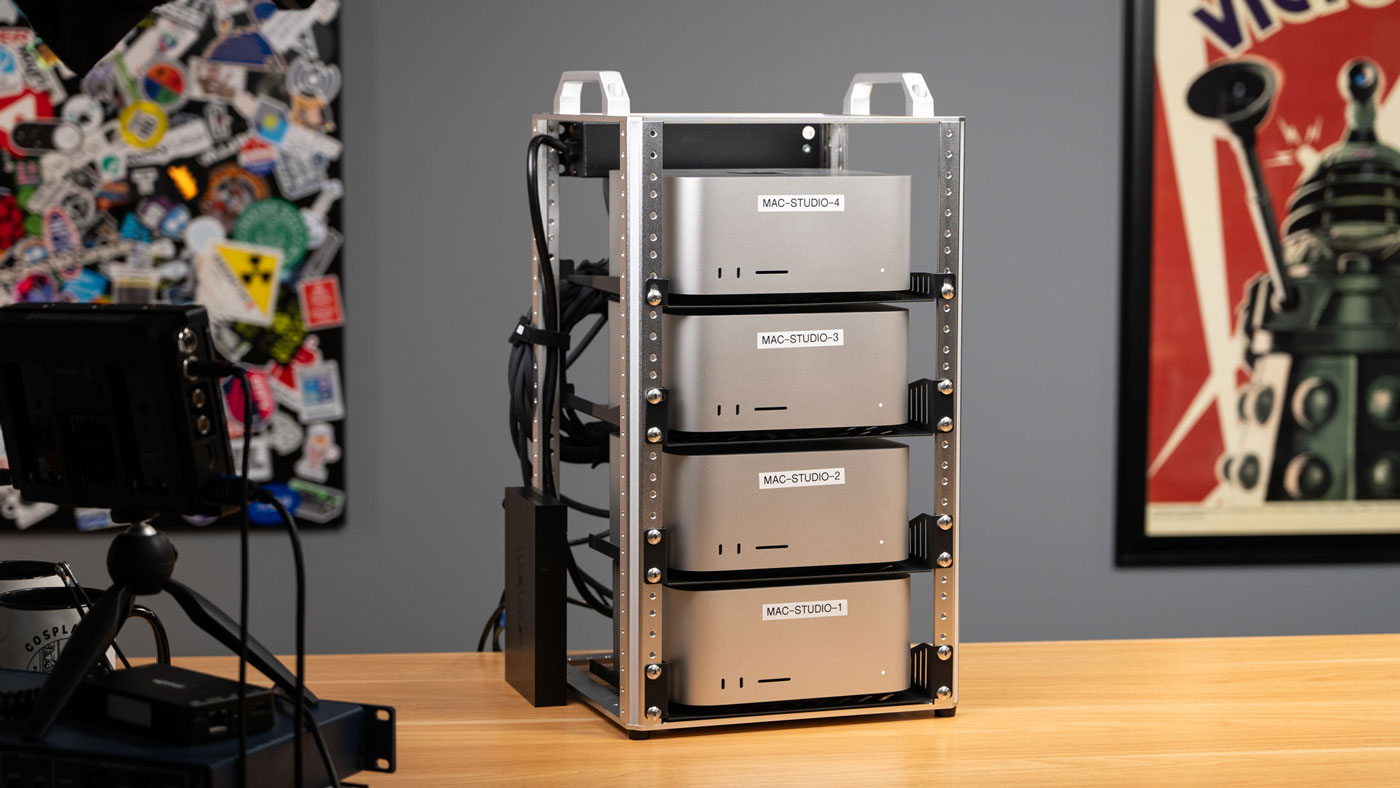
1.5 TB of video memory on Mac Studio — RDMA over Thunderbolt 5
Author: Jeff Geerling. Originally published on December 18, 2025. Full translation for XORit. Original article. The first-person narrative, assessments, and time references below belong to the author and refer to the date of the original publication. Photos and graphics are from the original. Apple provided me with this Mac Studio cluster to test RDMA over…
Management of web projects and servers with ispmanager panel
We cover the key aspects of managing server infrastructure with ispmanager: website deployment, web server and database configuration, antivirus protection, integrations, security and reliability. A well-configured server starts with a convenient control panel.
Office network setup for small and medium-sized businesses
We have reviewed key aspects of office network organization – network segmentation (VLAN), router and Wi-Fi configuration, antivirus protection (using Kaspersky Lab solutions as an example), video surveillance integration, as well as recommendations on which services are better moved to the cloud (including the XORit cloud) and what to keep local. Importance of proper network…

IT infrastructure mistakes of small businesses in Russia
IT infrastructure efficiency and security are critical for small businesses. However, in Russia companies often…