
OpenAI claims to have solved one of the ‘Millennium Problems’—the Navier–Stokes equations
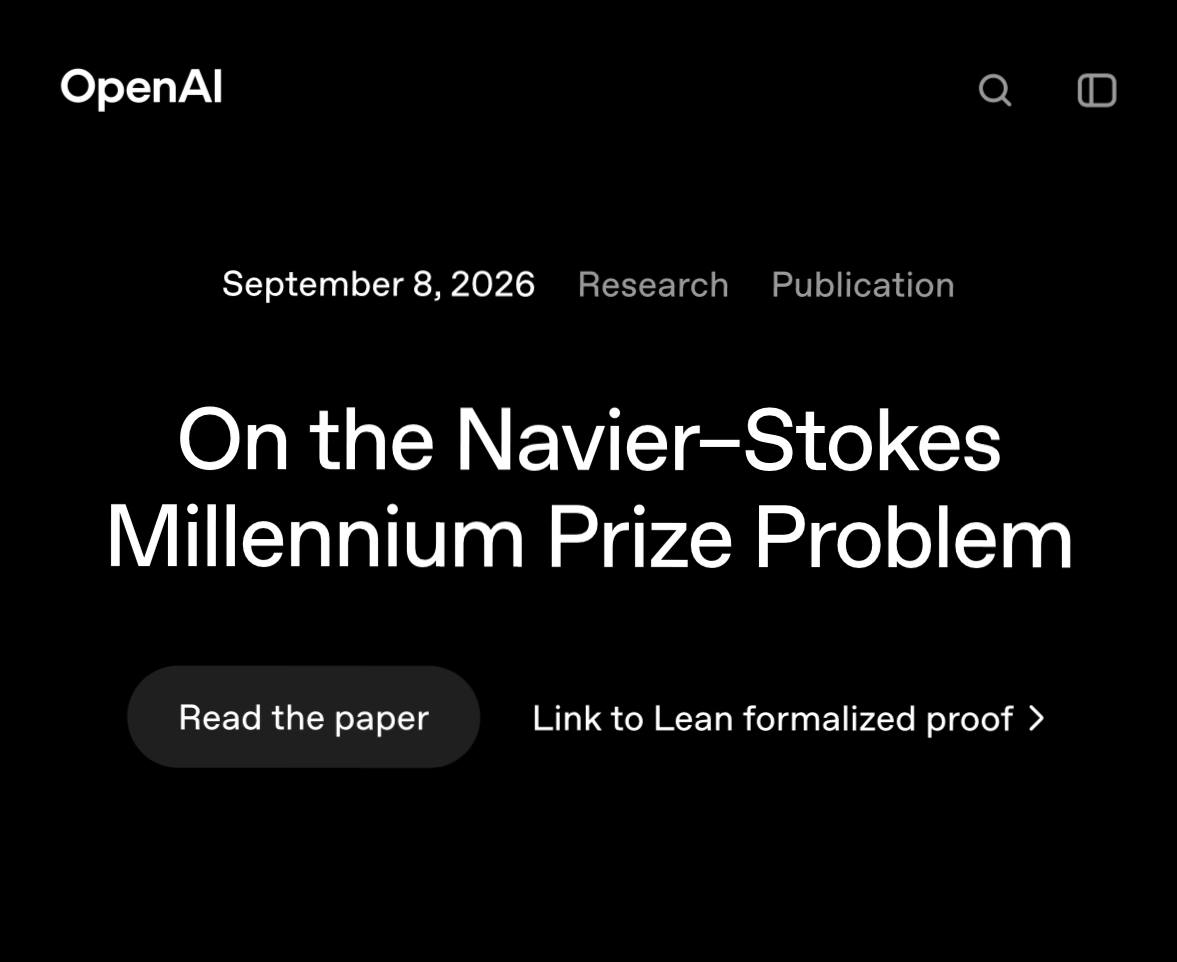
OpenAI announced the solution to the problem of existence and smoothness of solutions to the Navier–Stokes equations—one of the seven ‘Millennium Problems’ of the Clay Institute. According to the company, an internal system of around 10,000 AI agents proved that in a three-dimensional incompressible fluid, smooth flow can break down in finite time—a singularity will occur. The proof was published along with a formalization in the Lean language.
The question remained open for about 90 years. The Navier–Stokes equations describe the motion of liquids and gases as a continuous medium and are used in weather forecasting, aerodynamics, and blood flow modeling. However, mathematically it was unknown whether smooth solutions always remain smooth or can break down in finite time.
The claimed result concerns the case of a three-dimensional incompressible fluid with a smooth external force and finite energy. If the proof is confirmed, this would mean that singularities—points where velocity or vorticity become infinite—can arise within the continuum model. It is important to understand: this does not mean that a real fluid can accelerate to infinite speed; it is about a mathematical model.
OpenAI emphasizes that the model used is ‘more capable than Astra’ and the successful group consisted of about 10,000 agents working in parallel. The company does not intend to claim the million-dollar prize established by the Clay Institute.
OpenAI’s statement says the result should be attributed to the authors, not the company, and that independent verification by the mathematical community is still pending. Formalization in Lean should facilitate verification, but recognition of the proof may take months or years.
If the result is confirmed, it will be an important step in understanding one of the fundamental problems of mathematical physics and will demonstrate the capabilities of AI in solving complex mathematical problems.
Primary source: openai.com ↗