
On this day: the 1755 earthquake that gave birth to seismology
XORit Editorial · Sources, AI assistance and corrections
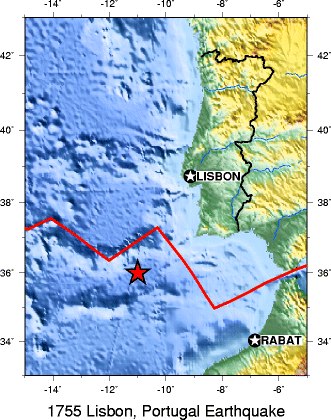
On 1 November 1755, All Saints' Day, at about 09:40 local time, an earthquake destroyed Lisbon. The epicentre lay in the Atlantic Ocean roughly 290 kilometres south-west of the city. Modern estimates of the magnitude vary: from 7.7 to 9.0. About 40 minutes later a tsunami struck the harbour and the lower town, and two more waves followed. Fires started almost at once: candles lit in homes and churches for the holiday were knocked over and set the city alight.
The fire raged for hours and suffocated people even 30 metres from the flames. By the estimates of the economic historian Álvaro Pereira, between 30,000 and 40,000 people died in Lisbon out of some 200,000 inhabitants, and up to 10,000 more may have died in Morocco. Total losses in Portugal, Spain and Morocco are estimated at 40,000 to 50,000 people. In the city 85 percent of the buildings were destroyed, along with the Ribeira royal palace, a library of 70,000 volumes and the royal archives holding records of Vasco da Gama's expeditions.
The prime minister, Sebastião José de Carvalho e Melo, the future Marquis of Pombal, survived and took charge of the rescue work. Asked what should be done, he is said to have replied: “Bury the dead and heal the living.” Bodies were carried out on barges and buried at sea beyond the mouth of the Tagus to prevent epidemics. To combat looting, the army was brought into the city and gallows were set up on high ground; more than thirty people were publicly executed.
A new city in place of the old
On 4 December 1755, little more than a month after the disaster, the kingdom's chief engineer, Manuel da Maia, presented four reconstruction plans, ranging from abandoning the city altogether to building it anew. The king and Pombal chose the most radical: to demolish the Baixa district and lay out new streets. In less than a year the city was cleared of rubble. The houses of the new lower town were given a wooden frame, the “Pombaline cage”, one of the first earthquake-resistant structures in Europe. The strength of the models was tested by marching soldiers around them and simulating tremors.
Pombal sent a questionnaire to every parish in the country: when the earthquake began and how long it lasted, from which direction it was felt most strongly, how many people died, whether the water rose and by how much. The priests' answers are kept in the Torre do Tombo national archive and are still used to reconstruct the events. For this large-scale, objective study of the earthquake, Pombal is regarded as a precursor of modern seismology.
The dispute over the causes
The catastrophe greatly influenced European thinkers. Voltaire responded with a poem about the Lisbon disaster, and later put its lesson into “Candide”, where he mocked the idea of the best of all possible worlds. Rousseau blamed the severity of the consequences on the crowding of people in the city. Immanuel Kant published three texts on the earthquake in 1756 and, having gathered the available reports, sought natural causes for the event rather than divine will.
This earthquake is considered the first to be studied scientifically across a large area. Modern seismology and earthquake-resistant construction are dated from it. By a 2009 estimate, the damage amounted to between 32 and 48 percent of Portugal's GDP.
Image: USGS Public domain

Translation editor: Ловушкин А.
Source: en.wikipedia.org ↗