
Google unveils Gemini 4 Neon with a separate version for cyber defense
XORit Editorial · Sources, AI assistance and corrections
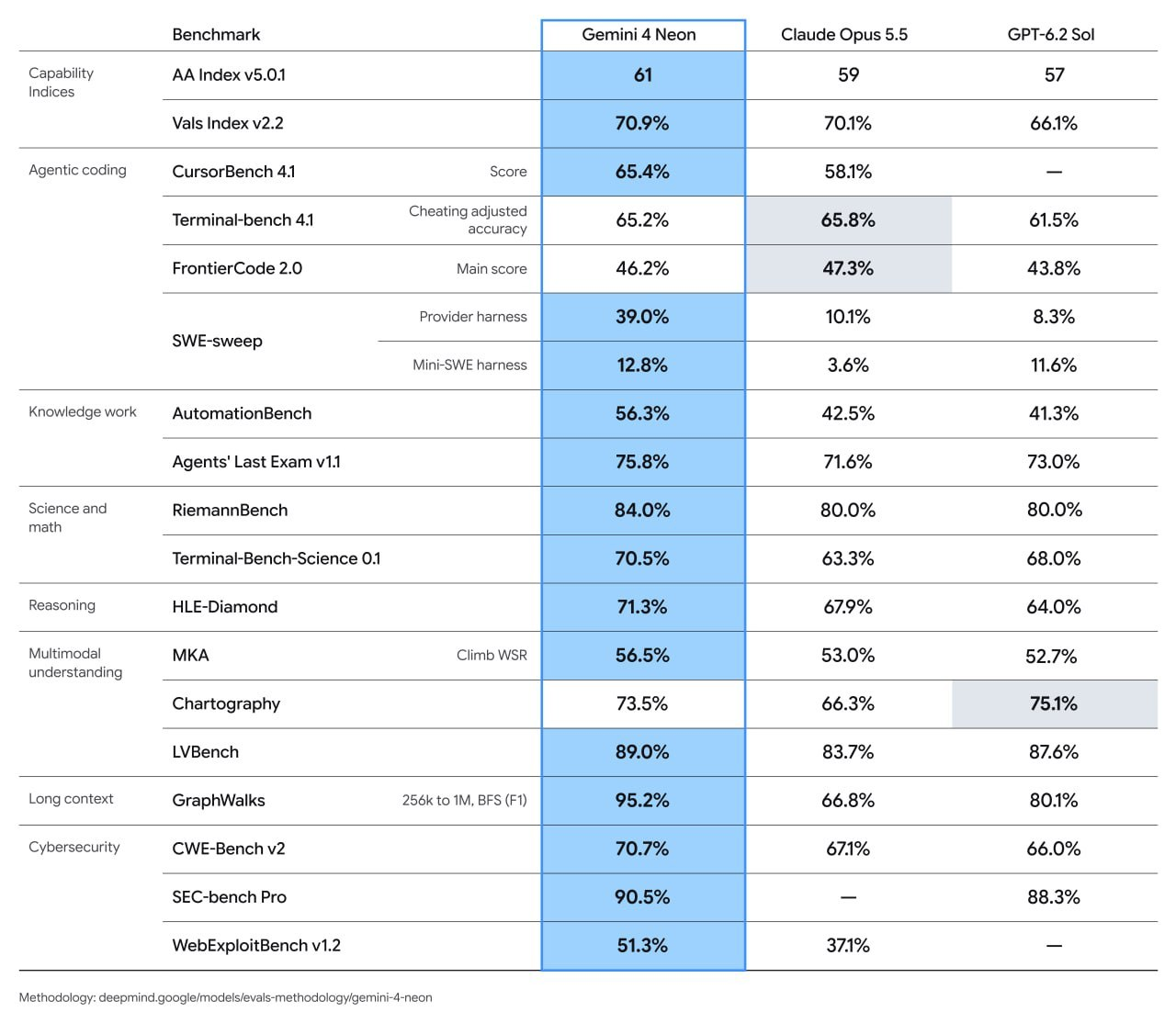
On November 18, 2026, Google introduced Gemini 4 Neon, a model for complex tasks in development, analytics and scientific computing, with fast execution of work from start to finish. According to the company, the model ranks third overall on the Artificial Analysis Intelligence Index with 61 points at the xhigh reasoning level, behind only larger and slower models.
On the Vals Index, Neon is second and sits on the Pareto frontier, and in the new Agent Arena Index it ranks second for steerability, meaning the ability to take in clarifications as a task proceeds. Google also notes the lowest fabrication rate in its own Antigravity tests.
Pricing is $3 per million input tokens, $0.15 per million cached input tokens at a 95% discount, and $15 per million output tokens, with a context window of 1 million tokens. The model has four reasoning levels, and at the standard high level the cost of completing a task is 32% lower than with Gemini 4 Carbon.
The model is already being rolled out in the Gemini API in Google AI Studio, in Gemini for business via the API and model selection, in Google Antigravity for paid AI Pro and Ultra subscribers, and in the Gemini app for Pro and Ultra subscribers.
A version for cyber defense
For defenders, Google is preparing Gemini 4 Neon for cyber: this variant looks for vulnerabilities in code, checks which of them can be exploited, and fixes their root causes. The company reports 90.5% on SEC-bench Pro at roughly half the cost per task, 51.26% on WebExploitBench v1.2 and 70.7% on CWE-bench v2, which is 3.4% above Carbon's result. Access will begin for Fairwind program participants in the coming days, and it can be requested through the account team in Cloud.
In the Gemini 4 lineup, the model takes the place between Carbon, designed for the longest projects, and Hydrogen for fast everyday tasks: Neon combines depth of reasoning with lower cost and speed.
Translation editor: Салтанов А.
Source: blog.google ↗