
Astronomers detect radio emission from an exoplanet for the first time — the giant planet β Pictoris b
XORit Editorial · Sources, AI assistance and corrections
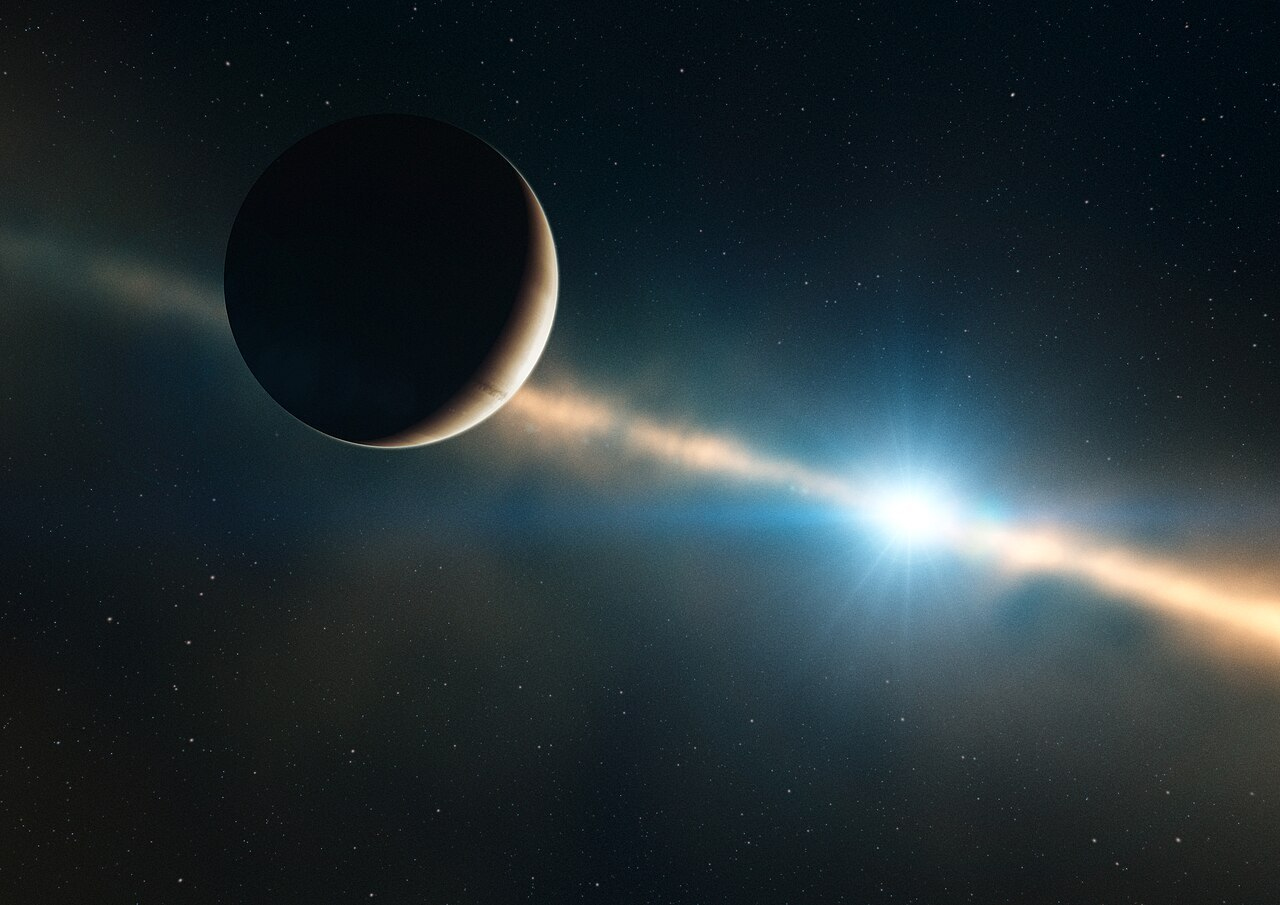
Astronomers have directly detected radio emission from an exoplanet for the first time — the gas giant β Pictoris b. The observations were made with the MeerKAT radio telescope array, and the results are set out in arXiv preprint 2609.16720, submitted on 15 September 2026. This is the first case in which a radio signal has been tied specifically to a planet beyond the Solar System.
The data show fast, repeating bursts with high circular polarization at frequencies from 0.85 to 3.5 GHz, as well as persistent emission. This pattern is consistent with the planet's auroral radio emission.
The mechanism is the electron cyclotron maser instability. The maximum frequency at which such a maser can emit is set by the magnetic field strength at the source. Auroral radio bursts have long been known from planets in the Solar System and from some ultracool dwarfs, but previously no radio detection could be unambiguously localized to an exoplanet rather than to its star.
That limitation has now been removed: the authors attribute the emission to β Pictoris b itself and, from the signal parameters, estimate the planet's magnetic field at no less than 1.25 kG. This is the first direct measurement of an exoplanet's magnetic field strength, whereas for Solar System planets such measurements had been made before.
Planetary magnetic fields govern atmospheric escape, determine interaction with the stellar wind, and carry information about internal structure — so a direct field measurement matters for comparative planetology. The preprint was prepared by Kevin N. Ortiz Ceballos, Edo Berger and Yvette Cendes; the work runs to 32 pages, 9 figures and 3 tables.
Image: ESO/L. Calçada CC BY 4.0 · License

Translation editor: Ловушкин А.
Source: arxiv.org ↗