
Niels Bohr: the creator of the atomic model was born on 7 October 1885
XORit Editorial · Sources, AI assistance and corrections
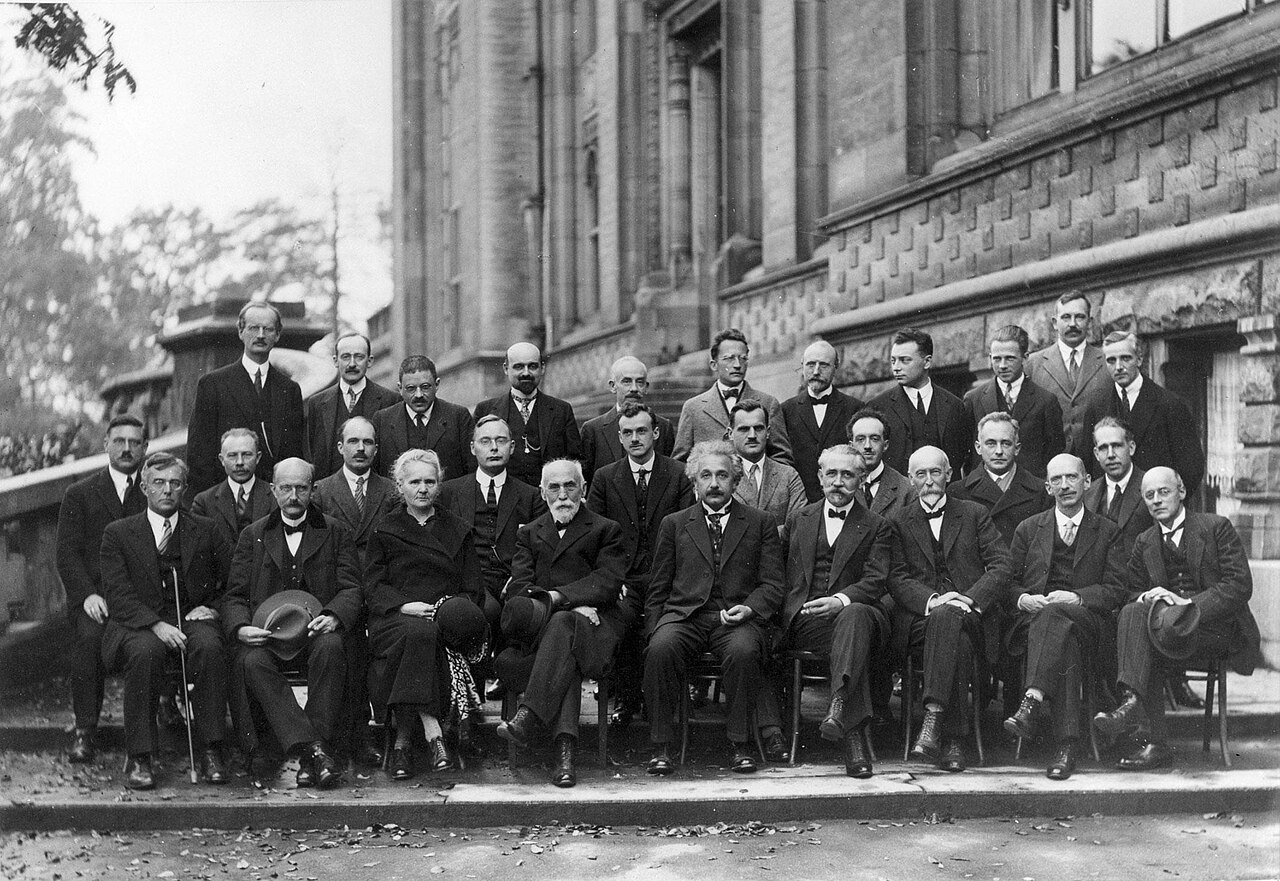
Niels Henrik David Bohr, the Danish theoretical physicist whose work laid the foundation of quantum theory, was born in Copenhagen on 7 October 1885. He was the second of three children of Christian Bohr, a professor of physiology, studied at the University of Copenhagen, and in 1922 received the Nobel Prize in Physics for his research into the structure of atoms and radiation.
The Bohr model
In 1913 Bohr published three papers in the Philosophical Magazine that later became known as the trilogy. In them he combined Rutherford's nuclear model of the atom with Planck's quantum concepts: electrons move along stable orbits with discrete energy levels and can pass between them, emitting or absorbing a quantum of energy. This is how the Bohr model came about, and with it what is known as the old quantum theory.
The model explained what had remained a mystery for thirty years. Back in 1885 Johann Balmer had described the visible spectral lines of hydrogen with his formula, but no one understood why it worked, and Bohr derived it from his postulates. He also predicted the properties of an element then unknown, with atomic number 72, similar to zirconium; it was named hafnium, after the Latin name for Copenhagen.
The institute in Copenhagen
In Copenhagen Bohr founded the Institute for Theoretical Physics. In the 1920s and 1930s it became a centre of research in quantum mechanics, and many of the leading theorists of the time worked there. Today it is the Niels Bohr Institute: the institute was renamed on 7 October 1965, on Bohr's eightieth birthday. He is also the author of the principle of complementarity, according to which properties such as wave and particle manifest depending on the setup of the experiment.
War and the post-war years
As early as the 1930s Bohr helped scientists fleeing Nazism, and in 1943 he himself was forced to leave occupied Denmark and reach Britain via Sweden. There he joined the British nuclear weapons project and took part in the work of the Manhattan Project in the United States. After the war Bohr called for international cooperation in atomic energy and took part in the creation of CERN. He died on 18 November 1962 in Copenhagen.
The Bohr model long ago gave way to modern quantum mechanics, but it remains the most recognisable image of the atom and still appears in school textbooks of physics and chemistry. The chemical element bohrium, with atomic number 107, was named in honour of the scientist.
Image: Benjamin Couprie Public domain

Translation editor: Ловушкин А.
Source: en.wikipedia.org ↗