
On October 11, 1950, the FCC Approved the CBS Color Television Standard
XORit Editorial · Sources, AI assistance and corrections
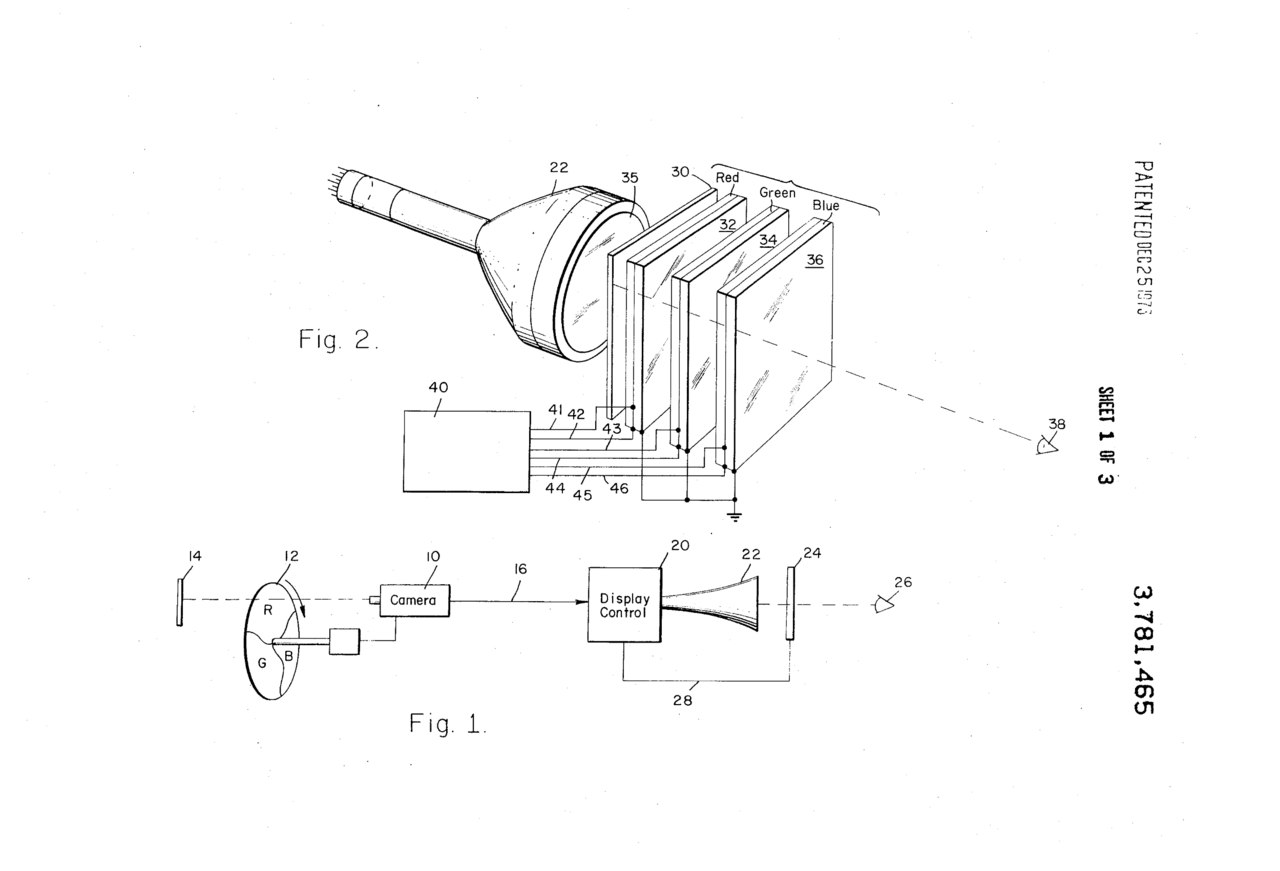
On October 11, 1950, the US Federal Communications Commission approved the CBS color television system as the country's standard. It belonged to field-sequential color systems: information about red, green, and blue was sent in turn in separate fields, and human vision itself combined them into a color picture. One variant of such a system had been developed back in 1940 by Guillermo González Camarena.
How the system works
The CBS system was mechanical: inside the camera and the receiver, a disk with color filters rotated, making 1440 revolutions per minute and letting red, green, and blue through in turn. To keep the individual color images from flickering, the field rate was raised from 60 to 144 per second, which gave 24 full color frames per second. To fit within the standard 6 MHz band, vertical resolution was reduced from 525 to 405 lines. Vertically this is 77% of black-and-white, horizontally 54%.
The broadcast was not compatible with ordinary black-and-white televisions. To see it in black-and-white, an adapter was required, and for color a converter adapter was needed.
Before it reached the standard, the system was demonstrated more than once. The press saw it on September 4, 1940, a live picture from studio television cameras was demonstrated in 1941, and the system was first shown to the general public on January 12, 1950. Public tests began in November 1950, after the FCC decision.
Regular broadcasts
CBS began regular color broadcasts on June 25, 1951, in New York, seven days a week, opening them with an hour-long variety show by Arthur Godfrey. In June 1951 Philco offered 11 television models that received CBS broadcasts in black-and-white. When no one wanted to manufacture color receivers, CBS in April 1951 bought its own manufacturer; production of CBS-Columbia models began in September, and they went on sale in October.
On October 20, 1951, CBS suspended color broadcasting, showing a football game between the universities of North Carolina and Maryland as a farewell. The shutdown came mainly at the demand of the National Production Authority, which during the Korean War banned the manufacture of color televisions for the general public. In total, 200 color receivers for sale were made, and 100 of them were shipped. In March 1953 CBS announced it was abandoning its system.
While CBS was winding down, RCA continued to improve the compatible NTSC system, first demonstrated in 1949. By the spring of 1953 RCA had prepared a fully electronic color television system, which NTSC adopted, and on December 17, 1953 the FCC authorized its public use. Thus field-sequential color gave way to an electronic standard.
Image: M Ernstoff; E Fehr; W Hoffman; R Winner Public domain

Translation editors: Соловьев В., Пеков А.
Source: en.wikipedia.org ↗