
Brain organoids helped recognize Braille signals
XORit Editorial · Sources, AI assistance and corrections
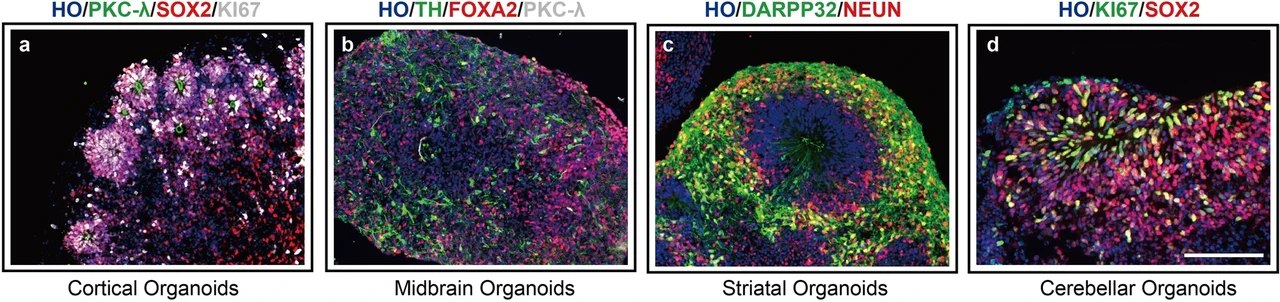
Researchers at the University of Bristol tested whether signals corresponding to Braille letters could be recognized from the activity of lab-grown brain organoids. The results were published on October 16, 2026, in Frontiers in Artificial Intelligence.
A tactile sensor read patterns for 26 Braille letters. The resulting data were converted into electrical signals and delivered to organoids placed on multi-electrode arrays. A computer algorithm then classified the resulting neural activity and identified which letter corresponded to each signal.
The algorithm correctly recognized a letter from the activity of one organoid in 61% of cases. When the responses of three organoids were combined, the proportion of correct recognitions was 83%. In a test with artificial noise, decoding the organoids’ responses distinguished letter signals better than directly analyzing the noisy data without organoids.
The authors emphasize that the experiment showed that the organoids received signals and responded to them, but did not test whether they could learn over time. The researchers view the work as a step toward studying biohybrid computing, which combines artificial sensors with biological neural systems.
Image: Xiao-Yan Tang, Shanshan Wu, Da Wang, Chu Chu, Yuan Hong, Mengdan Tao, Hao Hu, Min Xu, Xing Guo & Yan Liu CC BY 4.0 · License

Translation editor: Ловушкин А.
Source: www.bristol.ac.uk ↗