
September 7, 1927: First electronic television picture
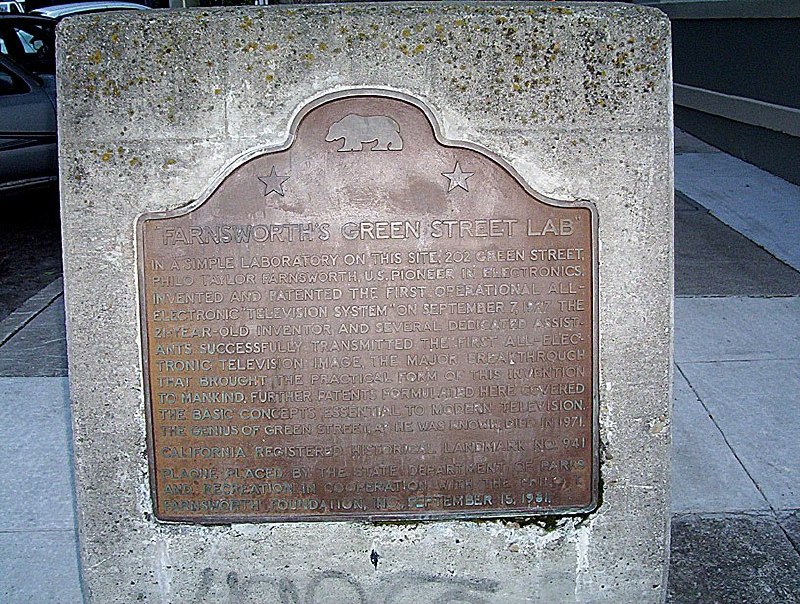
On September 7, 1927, in a laboratory on Green Street in San Francisco, young inventor Philo Farnsworth demonstrated a fully electronic television system. His device, called the “image dissector,” transmitted the first image to the next room — a simple straight line. As the inventor’s wife recalled, after tense silence he said: “There you have it — electronic television!”
Farnsworth was 21 at the time. Unlike the electromechanical systems of that era, which used spinning disks to scan images, his approach was fundamentally different: scanning was done entirely electronically, with no moving parts. Later, in 1929, the system was refined to the point that even the motor-generator was eliminated.
The image source that day was a glass plate illuminated by a bright arc lamp. Due to the low light sensitivity of the dissector, very powerful light was required. By 1928, Farnsworth had brought the system to a press demonstration, and the first image shown to the public was a dollar sign — investors wanted to ensure the invention would be profitable.
The first American television patent was issued to Farnsworth. In 1930, he received a patent for his television system and later won a patent dispute with RCA, proving priority in inventing the image dissector. This became an important milestone in the history of television.
Farnsworth’s invention paved the way for modern television, fully electronic in its operation. Although electromechanical systems existed before him, it was his work that laid the foundation for practical television as we know it. Today this day is remembered as the moment television ceased to be a mechanical curiosity and became an electronic technology.
Image: Image card · License

Primary source: en.wikipedia.org ↗