
OpenAI launches GPT-6 Sol and GPT-6 Luna — cheaper than Astra at the same generation quality
XORit Editorial · Sources, AI assistance and corrections
OpenAI has expanded the GPT-6 family with two models, Sol and Luna. They were trained with methods similar to those used for the flagship GPT-6 Astra, in order to carry its strengths in professional tasks, fact work, coding and computer use into a faster and cheaper format. Astra remains the company's strongest model — it is the one to choose when you need maximum results with no compromises.
The key difference is price. API pricing for Sol and Luna is half what it was relative to GPT-5.6 promotional prices: input for Sol dropped from $4 to $2 per million tokens and output from $20 to $10, while Luna went from $0.20 to $0.10 and from $1.20 to $0.50 respectively. The savings come from improvements in caching and inference, and the company is passing them directly on to customers.
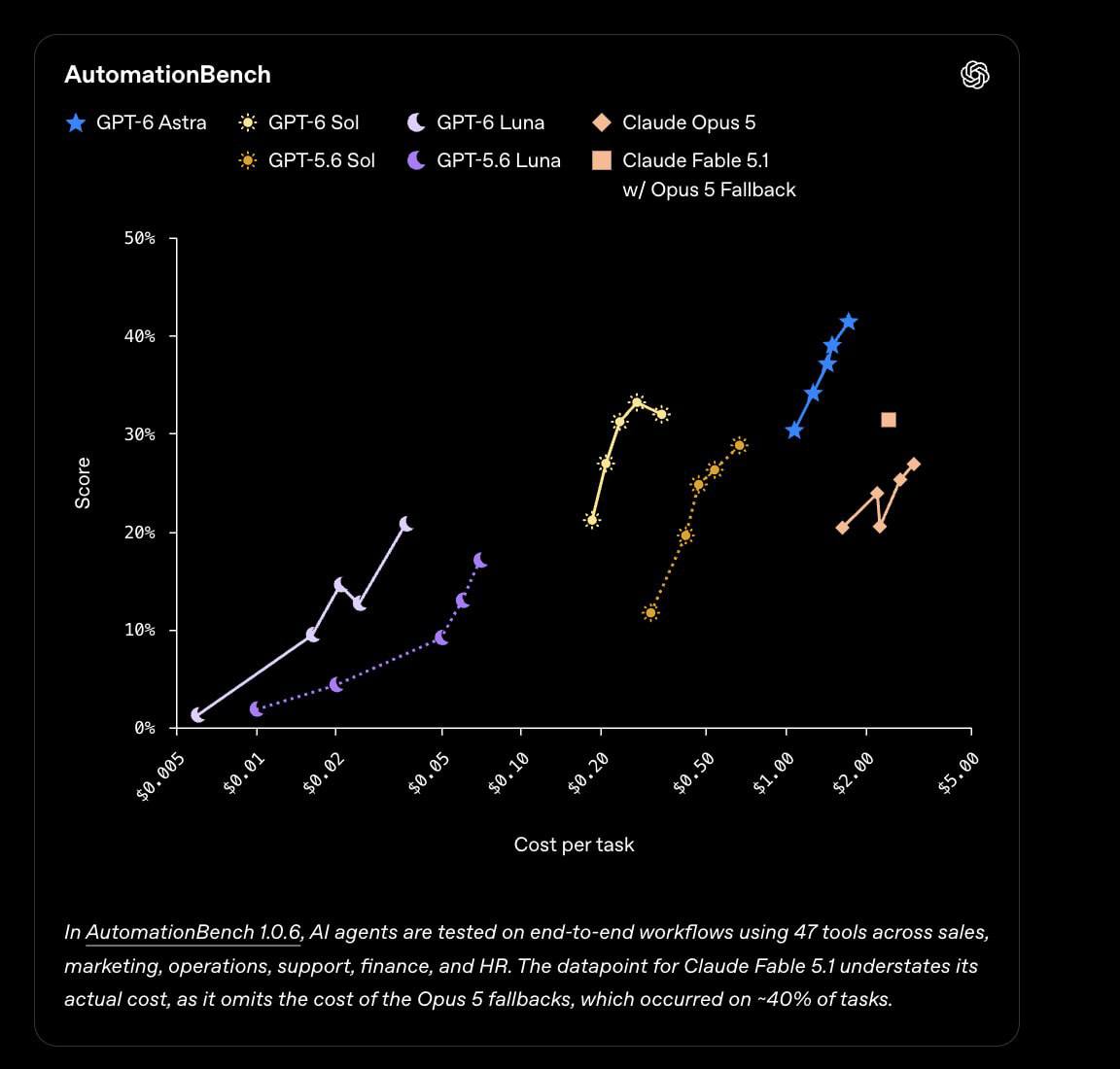
On AutomationBench, which tests agents on end-to-end workflows with 47 tools, GPT-6 Sol at maximum effort scores 33.2% versus 26.9% for Claude Opus 5, while spending about 9% of its cost per task. GPT-6 Luna at high effort beats its predecessor by 5.4 percentage points at a 58% lower cost per task.
In other tests, Sol at maximum effort shows 56.4% on Agents' Last Exam — above Opus 5's best result at roughly 60% lower cost per task — and 68.8% on DeepSWE, trailing the best 69.9% from Claude Fable 5 by 1.1 points. On OSWorld 2.0, Sol scores 60.5% versus 60.3% for Opus 5 at roughly 80% lower cost.
OpenAI tested factual accuracy on anonymized real conversations where users flagged model errors: there Sol makes roughly half as many mistakes as its predecessor and approaches Astra's reliability at a noticeably lower price. Luna at high effort catches up with GPT-5.6 Sol for about one hundredth of its cost. Both new models also improved their alignment scores relative to GPT-5.6.
Prompt caching was improved as well: the default cache hit rate is higher, and reading cached input tokens comes with a 90% discount. According to GitHub, these changes more than halved the share of tokens requiring fresh processing across billions of requests to OpenAI models.
GPT-6 Sol and GPT-6 Luna are already available in ChatGPT Work and Codex for Plus, Pro, Business, Enterprise and Edu subscribers, and via API under the names gpt-6-sol and gpt-6-luna. Free users and Go subscribers can get Luna in the desktop app. The models are not yet in regular ChatGPT, and the rollout in Work and Codex is happening gradually over the course of the day.
Image: FoxTPNL CC BY 4.0 · License

Translation editor: Салтанов А.
Source: openai.com ↗