
On This Day: Gerolamo Cardano — Physician, Mathematician and Gambler
XORit Editorial · Sources, AI assistance and corrections
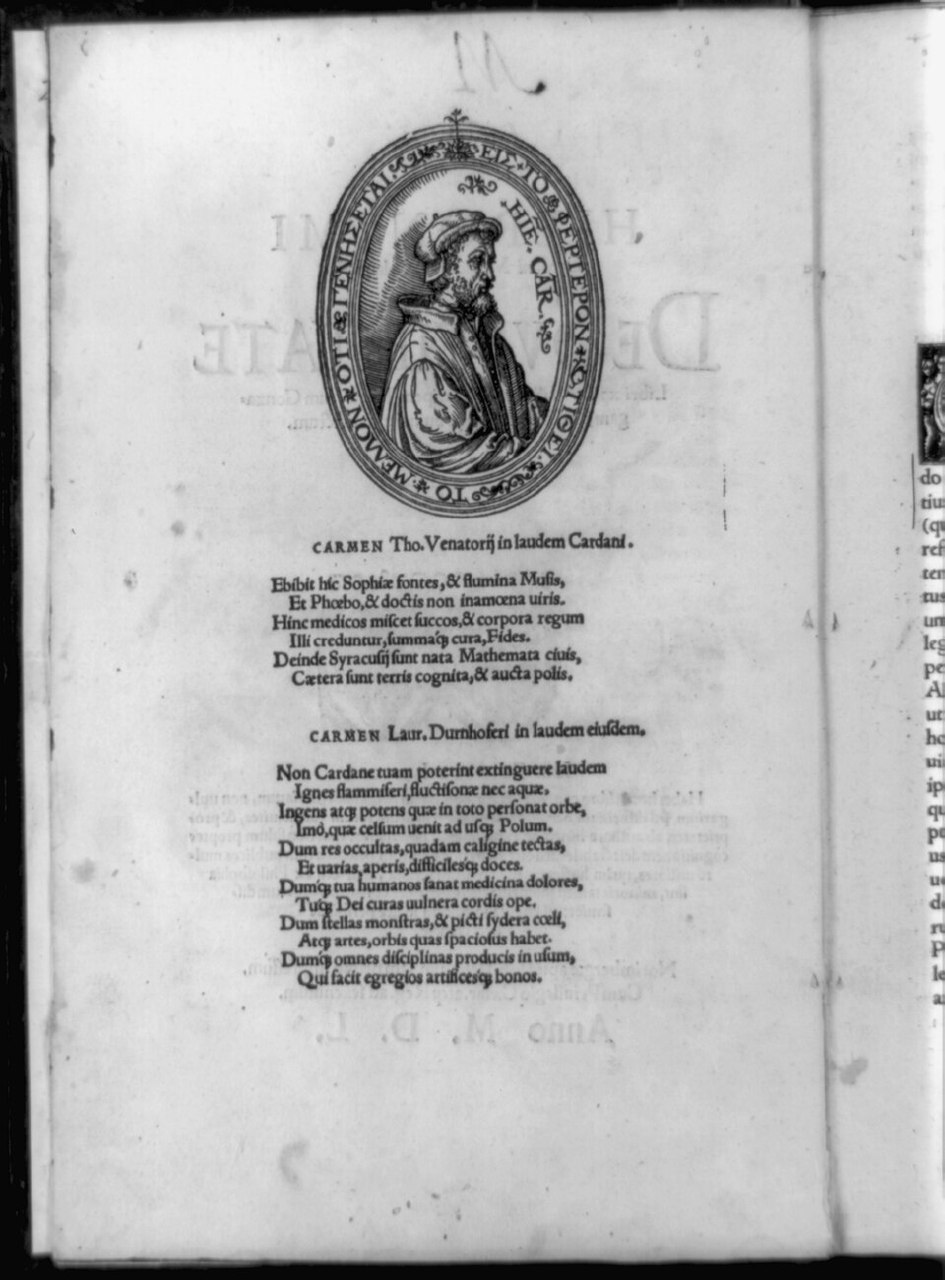
On 24 September 1501, Gerolamo Cardano was born in Pavia — a man hard to fit into a single profession. Physician, mathematician, astrologer, philosopher and inveterate gambler: his interests covered almost everything then called science, and in all he wrote more than two hundred works.
Medicine was his trade: after earning a doctorate in Padua, he became one of Milan's most sought-after physicians, and later took on the treatment of a Scottish archbishop who was considered beyond hope. But money never stayed with Cardano, and he covered his shortfall with dice and chess — it was gambling that made him take odds seriously.
His main mathematical mark was left in the book "Ars Magna" (1545). In it Cardano became the first in Europe to use negative numbers systematically, published solutions to cubic and quartic equations with attribution of authorship, and acknowledged the existence of imaginary numbers, though he understood their properties only dimly. There too he introduced binomial coefficients and the binomial theorem into the Western tradition.
Probability theory grew largely out of his gambling. He wrote the treatise "Liber de ludo aleae" ("Book on Games of Chance") around 1564, but it was printed only in 1663, after the author's death. In that work is the first systematic attempt to describe randomness: Cardano analysed dice throws and defined odds as the ratio of favourable outcomes to unfavourable ones.
He also worked on mechanics: he described the cardan shaft with universal joints, which still transmits rotation in machines today, and the gimbal suspension of rings that lets a compass or gyroscope hold its position. Cardano died in Rome in 1576, remaining in history as one of the most influential mathematicians of the Renaissance — and a man in whom science and gambling were directly connected.
Image: Miscellaneous Items in High Demand, PPOC, Library of Congress Public domain
Translation editor: Ловушкин А.
Source: en.wikipedia.org ↗