
October 2, 1955: ENIAC is switched off for the last time
XORit Editorial · Sources, AI assistance and corrections
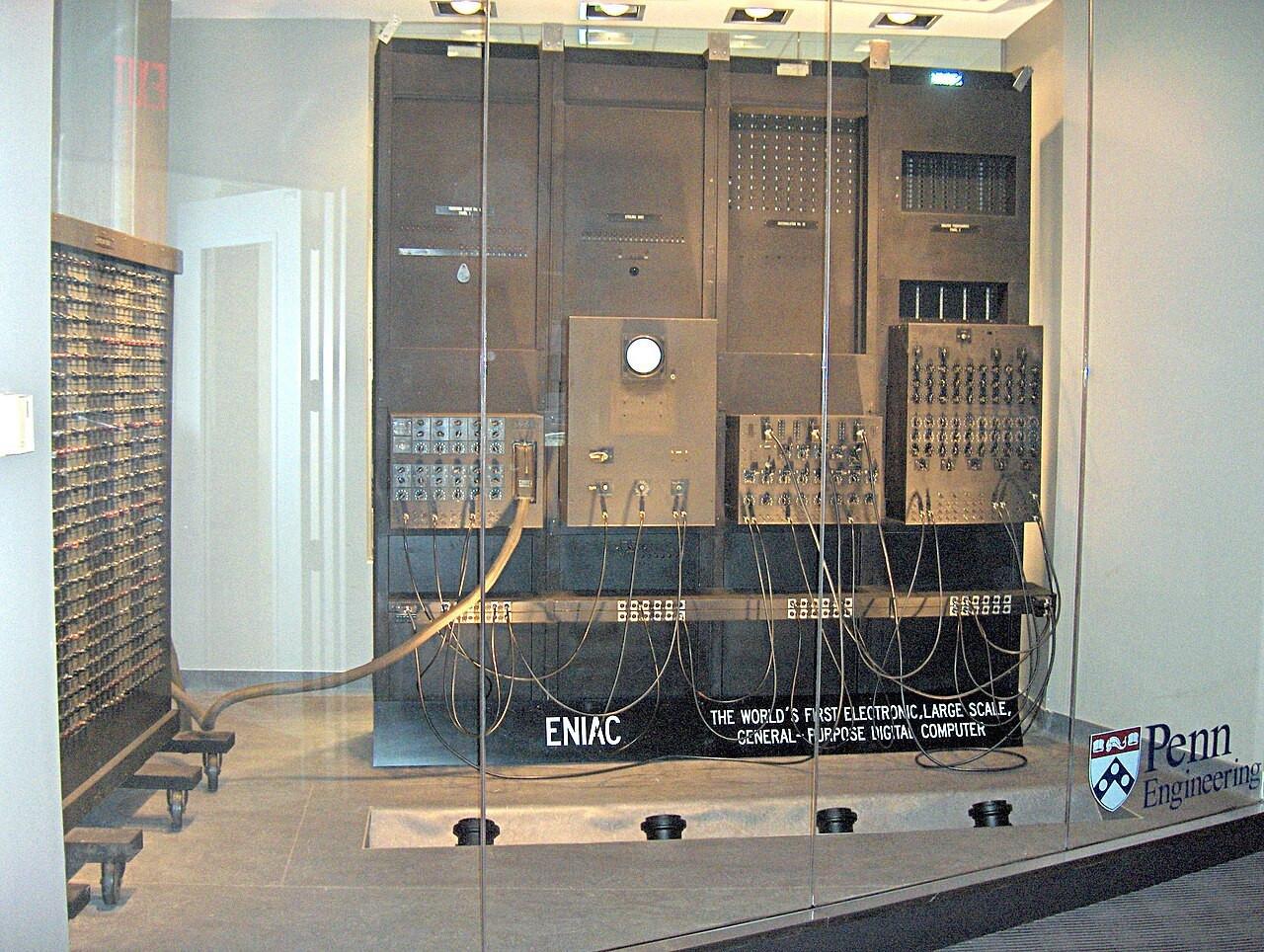
At 23:45 on October 2, 1955, ENIAC was switched off for the last time, ending its continuous operation at the Aberdeen Proving Ground in Maryland. The machine was retired in favor of the more capable EDVAC and ORDVAC. ENIAC is considered the first general-purpose programmable electronic digital computer: it was completed in 1945, and although individual features of such a machine had appeared before, here they all came together for the first time.
ENIAC was designed by John Mauchly and J. Presper Eckert. The U.S. Army ordered the machine primarily to compute firing tables at the Ballistic Research Laboratory, but its first real task was testing the feasibility of thermonuclear weapons. In December 1945, thermonuclear reactions were computed on ENIAC, and those data were used in work on the hydrogen bomb. Later, the work around ENIAC helped develop and popularize the Monte Carlo method.
By the end of its service in 1955, ENIAC contained 18,000 vacuum tubes, 7,200 crystal diodes, 6,000 relays, 70,000 resistors, 10,000 capacitors and about 5 million soldered joints. The machine weighed more than 30 short tons, stood roughly 3 meters high and 30 meters long, and consumed 150 kW. Its tubes failed almost every day, and the computer sat idle about half the time. Over time engineers reduced the failure rate to one tube every two days, and in 1954 the record for continuous operation reached 116 hours.
ENIAC was programmed not with code in the usual sense, but with switches and cables on panels, plus three portable function tables. Preparing a problem could take weeks, and transferring a program onto the machine through wires and toggle switches took days. Only in April 1948 was ENIAC first demonstrated as a stored-program machine: this slowed it down by a factor of six, but cut reconfiguration from days to hours.
The main program for ENIAC was written by six women: Kay McNulty, Betty Jennings, Betty Snyder, Marlyn Wescoff, Fran Bilas and Ruth Lichterman. They were classified as subprofessionals, even though they were mathematicians with degrees, and they were not invited to the machine's formal dedication in 1946. Recognition came decades later: in 1997 all six were inducted into the Women in Technology International Hall of Fame, in 2022 Kathy Kleiman's book about them was published, and in 2020 three U.S. Army supercomputers were named after Jean Bartik, Kay McNulty and Betty Snyder.
ENIAC remained a one-off design and was never replicated. Its creators began work on the simpler and more powerful EDVAC: back in 1944, Eckert described a memory device based on mercury delay lines that was meant to store both data and program. That concept formed the basis of the machine that replaced ENIAC.
Image: The original uploader was TexasDex at English Wikipedia . CC BY-SA 3.0 · License

Translation editors: Соловьев В., Пеков А.
Source: en.wikipedia.org ↗