
On this day: Britain carried out its first atomic bomb test
XORit Editorial · Sources, AI assistance and corrections
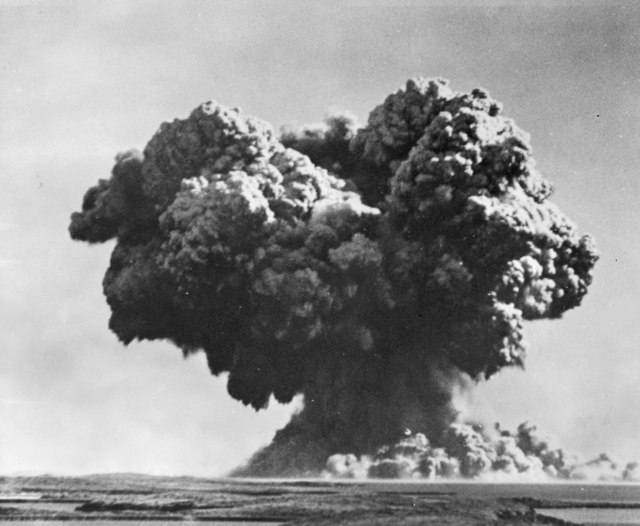
On 3 October 1952, off the Montebello Islands in Western Australia, the first British atomic device detonated. The operation was named Hurricane (Operation Hurricane). The plutonium implosion charge, with a yield of about 25 kilotons, made the United Kingdom the third nuclear power after the United States and the USSR.
The bomb, without its radioactive components, was assembled at Foulness and taken aboard the frigate HMS Plym, which then sailed to the Montebello Islands. The explosion was set off inside the hull of the ship, which lay at anchor about 350 metres from Trimouille Island. That was how the British tested what would happen if an atomic bomb went off in a port aboard a vessel. The blast occurred 2.7 metres below the waterline and left a crater on the seabed about 6 metres deep and 300 metres wide. Almost nothing remained of the frigate.
The yield of the explosion was estimated at 25 kilotons. The cloud of radioactive fallout rose to about 3 kilometres and was carried out to sea, as intended.
The path to the test took years. The British Tube Alloys project during the Second World War was merged with the American Manhattan Project, but after the war the United States ended cooperation on atomic weapons. In January 1947 the British government decided to revive its own programme, and William Penney led the development of the bomb. A suitable site was sought outside the country, and in May 1951 Australia agreed to give the Montebello Islands over for the tests.
The contamination of the islands was heavy, even though the cloud drifted out to sea. After the test it became clear that detonating an atomic bomb in a British port would have been a catastrophe. The islands remained a closed zone until 1992; today they are a park.
Image: (Naval Historical Collection) Public domain

Translation editor: Ловушкин А.
Source: en.wikipedia.org ↗