
AI agent found a planet candidate, TESS will check it in November 2026
XORit Editorial · Sources, AI assistance and corrections
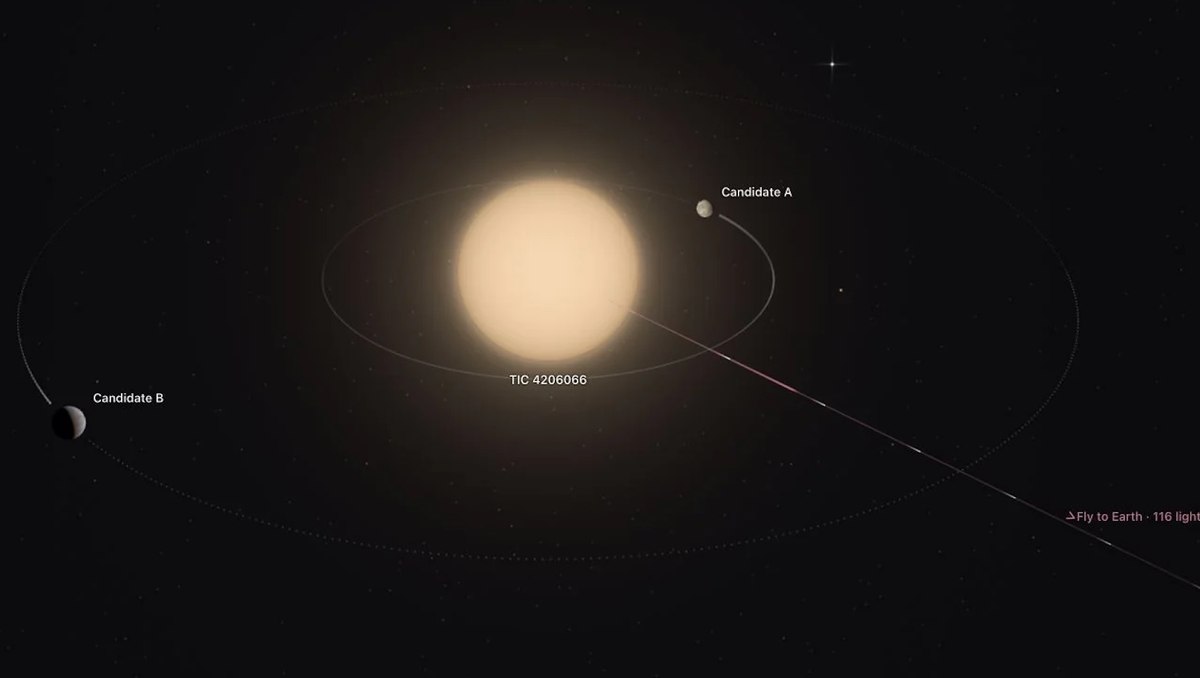
Independent researcher Pavel Rabtsevich, working in Tarragona, Spain, was going through the public archives of NASA's TESS space telescope using Claude Code, a programming agent from Anthropic. That is how he noticed a star that was behaving strangely. He published his story on Reddit, and its basis was a preprint posted on September 25, 2026, on Zenodo, a scientific repository provided by CERN.
Star TIC 4206066
This concerns the star TIC 4206066, a K-type dwarf that, according to the author's estimate, is 116 light-years from us. Every 3.18 days it loses about 0.05% of its brightness for roughly two hours. This pattern is visible in observations from late 2025, as well as 2020 and 2018: 23 transits in total. Neither the 36 catalogs examined nor the 340,505 automatic TESS alerts caught it.
If the object does indeed orbit this star, its radius is 1.4 Earth radii. There is also a second, much weaker signal: a body with a radius of 2.2 Earth radii and a period of 11.13 days. In the preprint, the false alarm probability is estimated in the range of 3 to 4%, and the author does not claim statistical confirmation and sticks to the term "planet candidate". He also stipulates: a signal found in sector 110 will not prove that it is a planet, but an inconclusive result will not show that the object is not there.
According to Rabtsevich, he delegated the execution to Opus 5.5 and Fable 5.1: they downloaded the data, wrote the search code, fitted the transits and looked for false positives. In about two weeks, 74 analyses accumulated, and they were rechecked by Codex and clean agent sessions in read-only mode. The researcher himself chose the questions and the failure criteria. The audit revealed an overly flattering statistical claim, and it was immediately retracted. The author's favorite check: hide a whole year of observations, compute the orbit from the two remaining ones, and then verify whether the transits fall at the predicted moments. Three attempts, three successes.
TESS will take a closer look at the star from October 31 to November 26, 2026
The observation request was accepted. It runs under number 100 in the list of TESS discretionary programs maintained by MIT, with a measurement every two minutes. The telescope will take a closer look at the star from October 31 to November 26, 2026.
On October 6, before the new data appeared, Rabtsevich posted a pre-registered protocol: nine predicted transits for the main signal and three for the second, accurate to within four minutes, frozen code, and four outcomes fixed in advance. It will not be possible to rewrite history after the fact. The document stipulates: a signal found in November will strengthen the case, but will not prove the existence of a planet. Confirmation will require other instruments and other views.
Translation editor: Салтанов А.
Source: www.lesnumeriques.com ↗