
Nikon revokes first place in microscopy competition over generative AI video
XORit Editorial · Sources, AI assistance and corrections
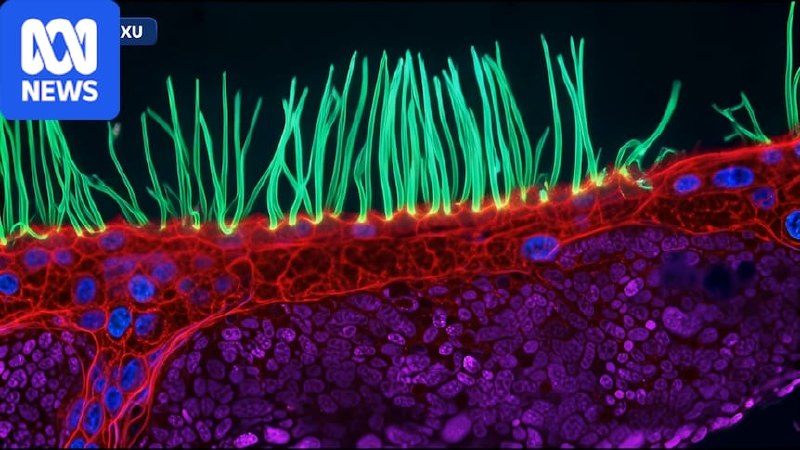
Nikon disqualified the winner of the Small World In Motion competition, which the company holds every year for the best photographs and videos taken through a microscope. First place was revoked from Ning Xu, at that time a researcher in optical engineering at Tsinghua University in China. The work, according to Nikon, did not comply with the competition's rules on generative AI. The company noted that the decision concerns only the eligibility of the work and is not an assessment of the author's reputation or his scientific contribution.
The video showed tiny cilia beating in the airways of a child with a rare genetic disease, primary ciliary dyskinesia (PCD). According to the author's description, the footage at 100x magnification used a complex set of light waves that illuminated different parts of the sample so that researchers could better understand the disease.
Experts' doubts
A few days after the winners were announced, microscopy specialists on social media doubted the authenticity of the footage. In comments under Nikon's LinkedIn post, which was later deleted, some scientists pointed out that the images of the nuclei did not behave like nuclei, while the cilia appeared out of nowhere and did not match the known size. Edward Phelps, an associate professor at the University of Florida, told the publication that the composition of the video felt like ordinary microscope images, and it is understandable why the jury might not have noticed the scientific problems right away: an expert on cilia would probably have recognized them faster. He added that artificially drawing in any part of a scientific image is unacceptable, since the task of microscopy is to make the small visible, not to create a false reality.
Xu objected that he had drawn in the areas under the cilia to improve the presentation, not for anatomical reconstruction. The scientific community sent the competition an open letter calling for the winners' works to be checked externally. The letter said that a misleading PCD image shapes the perception of a rare disease that is already poorly studied; the authors of the letter asked clinicians and researchers who diagnose and study PCD to sign the appeal and to press for Nikon to comply with its own rules.
New winner
After the scandal, first place was awarded to Vietnamese researcher Nguyen Nam Nhat. His video, which had originally taken second place, shows a microscopic roundworm encountering the single-celled organism Dileptus. The winner receives a prize worth 3,000 US dollars. The competition, held since 1975, is open to anyone interested in photography and time-lapse footage taken through a microscope.
Translation editor: Салтанов А.
Source: www.abc.net.au ↗