
‘Hubble’ captures for the first time the birth of a giant decagon on Saturn’s south pole
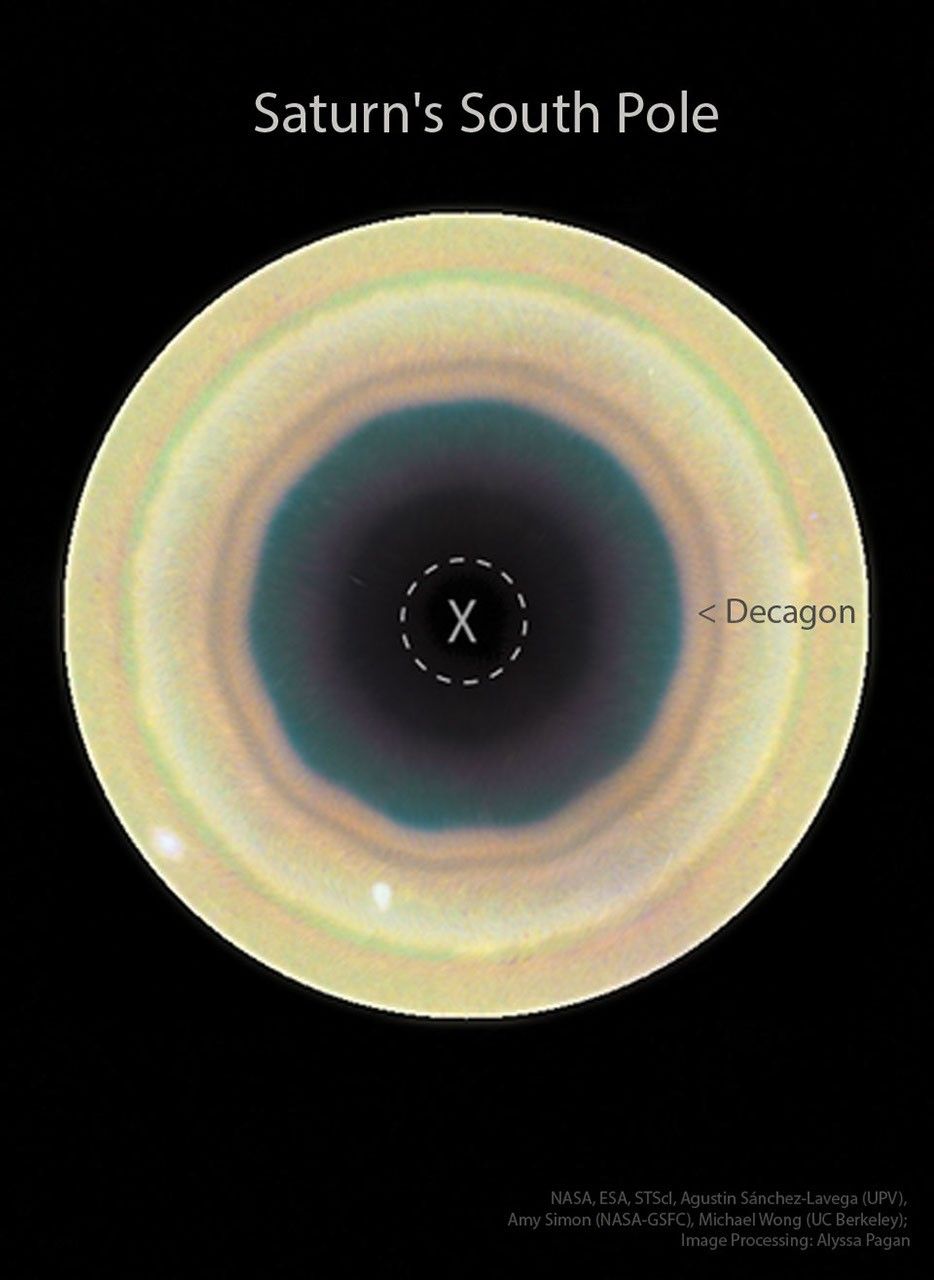
Astronomers working with data from the Hubble Space Telescope reported the discovery of an unusual atmospheric wave at Saturn’s south pole. In shape, it resembles a regular decagon and encircles the planet’s polar region. This is the first time that a large polygonal jet pattern, similar to the famous northern hexagon that has been observed for over 40 years, has been recorded in Saturn’s southern hemisphere.
The structure was revealed thanks to the OPAL (Outer Planet Atmospheres Legacy) program, under which Hubble photographs the outer planets of the Solar System annually. By comparing images from 2023, researchers noticed that the pattern gradually emerges and becomes increasingly clear. According to Amy Simon, co-author of the study and OPAL lead from NASA’s Goddard Space Flight Center, nothing like this had been seen before in Saturn’s southern hemisphere.
Unlike the northern hexagon, which has been stable for decades, the new decagon appears to be in a formative stage. Scientists emphasize that this is a rare opportunity to observe the birth of a giant atmospheric structure in real time. It is unclear why the pattern appeared now and how long it will last.
The first hints of an unusual wave were noticed by amateur astronomers in ground-based images of Saturn in 2024. Later, in 2025, additional observations from Earth indicated a decagonal shape. However, only Hubble, with its high resolution and ability to capture full rotations of the planet without atmospheric distortion, allowed confirmation of the discovery and traced the structure back to 2023.
It has been established that the decagon is located in one of Saturn’s powerful jet streams and extends through several layers of the atmosphere. This means that it is not just a cloud pattern but a vertically extended atmospheric structure. Its visible position changes slightly in images at different wavelengths because they probe different altitudes.
The results of the work were published in the journal Science Advances. The researchers intend to continue observing Saturn with the Hubble and James Webb space telescopes, and also use computer modeling. The goal is to understand the mechanism of formation of the hexagon, its stability, and its connection with the dynamics of atmospheres of giant planets in general.
The discovery highlights the value of long-term observational programs: only data accumulated over years allows noticing slow changes in planetary atmospheres and discovering new phenomena.
Image: Image card
.jpg)
Primary source: esahubble.org ↗