
Minsky, Rosenblatt, and the Perceptron: How the Book ‘Perceptrons’ Influenced the ‘AI Winter’
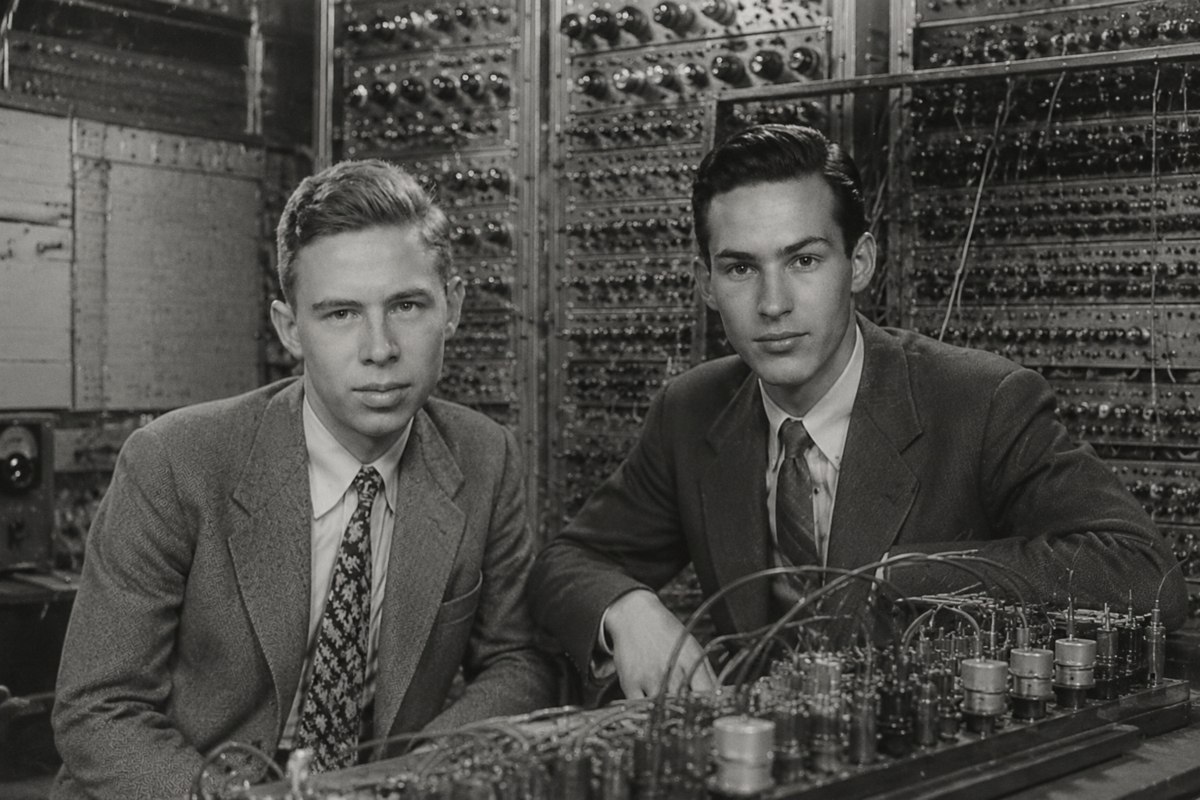
In 1969, the book “Perceptrons: An Introduction to Computational Geometry” by Marvin Minsky and Seymour Papert was published. The authors mathematically proved that the simple single-layer perceptron—an artificial neuron model proposed by Frank Rosenblatt in the late 1950s—cannot implement even the logical XOR function. This result is often cited as one of the reasons research on neural networks nearly ceased for a decade: the “AI winter” began.
The history of the rivalry was deeper than it seems. Minsky and Rosenblatt knew each other from youth: both attended the Bronx High School of Science a year apart. Rosenblatt published the first perceptron model in 1957, and Minsky and Papert dedicated their book to him. Despite sharp scientific disputes, they remained friends and were central figures in discussions in the AI community.
The main conclusion of the book concerned limited (“local”) perceptrons: if each hidden neuron is connected only to a small area of the input image, such a network cannot compute parity (determine whether an even or odd number of pixels are active) and cannot determine whether a figure in the picture is connected. The authors showed that to solve these tasks, neurons need connections to the entire input at once, which was difficult to implement in practice.
However, critics of the book noted that Minsky and Papert’s conclusions applied only to a narrow class of perceptrons with local connections. Rosenblatt himself proved that his “elementary perceptron” with an unlimited number of hidden elements can theoretically solve any classification problem. Moreover, back in 1943 Warren McCulloch and Walter Pitts showed that networks of formal neurons can compute any Boolean function—a fact mentioned in the book itself.
There are still debates about the book’s real influence. On one hand, after its publication, funding for neural network research sharply declined, and the community shifted to symbolic AI, which also eventually faced problems and led to the “AI winter” of the 1980s. On the other hand, the authors themselves in the 1988 expanded edition claimed that the decline of perceptrons was caused not by the book but by internal problems: the inability to train multilayer networks and the lack of a way to represent knowledge.
In the 1980s, neural network research experienced a revival thanks to multilayer networks and the backpropagation algorithm. David Rumelhart and colleagues claimed to have overcome the limitations described by Minsky and Papert, and that their pessimism about learning in multilayer machines was mistaken. The expanded 1988 edition of the book added a prologue and epilogue where the authors responded to criticism but contained no new scientific results.
Today, in the era of deep learning, the book “Perceptrons” remains an important historical document: it not only describes the mathematical limitations of early neural networks, but also illustrates how scientific polemics can influence the development of an entire field. In 2017 it was reissued with a foreword by Leon Bottou, a deep learning specialist, who considers the book from the perspective of modern achievements.
Primary source: en.wikipedia.org ↗