
Boston Dynamics unveils a four-fingered hand for Atlas with 13 degrees of freedom
XORit Editorial · Sources, AI assistance and corrections
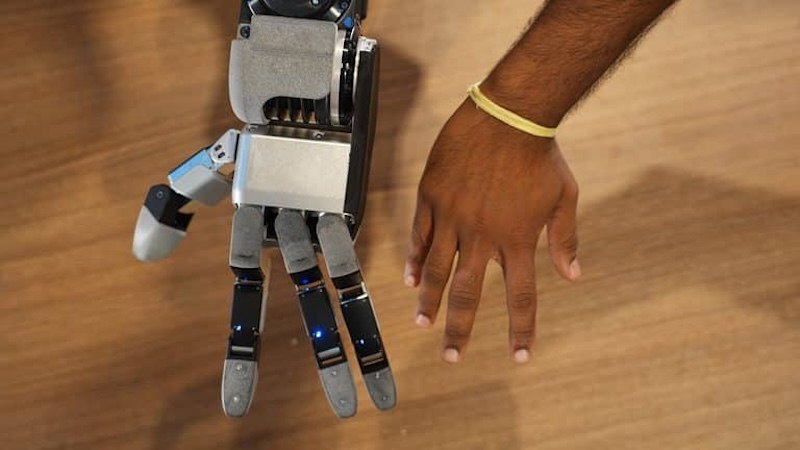
Boston Dynamics has unveiled a new hand for its humanoid robot Atlas, announced on October 2, 2026. The previous hand mainly grasped objects, while the new one works with them: it re-grips an object within the palm and holds it when it slips. It picks up a drill, a nutrunner, an angle grinder and a welding torch.
The hand has 13 degrees of freedom instead of the previous seven. The thumb is articulated, with four degrees of freedom, while the other three fingers have three each. The thumb moves along the length and width of the neighboring fingers, which allows different grip options. Its size is close to that of a large human hand: Atlas is designed for workspaces made for people, and the new hand is roughly as strong as the previous one.
Four fingers instead of five
There is no fifth finger, only four. The company tested whether a pinky was needed: for a day, employees had their pinky taped to their ring finger and watched which tasks would stop working. The experiment was proposed by CTO Zack Jackowski. In the end, they decided four fingers were enough, and the design comes out simpler and more reliable: an extra finger would have required three more actuators and added failure points.
Touch and learning
Dense tactile pressure sensors sit in the fingertips and on the palm; they complement the sensitivity of the actuators and help detect weak contact. The actuators are enclosed in the housing, all of the same type, and no cables pass through the joints: this simplifies manufacturing and repair.
The hand was designed with simulation and reinforcement learning in mind. A rigid actuator and a reversible transmission make it possible to reproduce the hand's behavior in a model, varying torque, friction and object geometry, and then transfer the skills to the real robot. Early results from such transfer already exist. The hand was created alongside the new fully electric Atlas, which is being prepared for industry and high-volume manufacturing.
Image: DARPA Public domain

Translation editors: Соловьев В., Пеков А.
Source: roboticsandautomationnews.com ↗