
Karpathy: the gap in understanding what language models can do has turned into a funnel
XORit Editorial · Sources, AI assistance and corrections
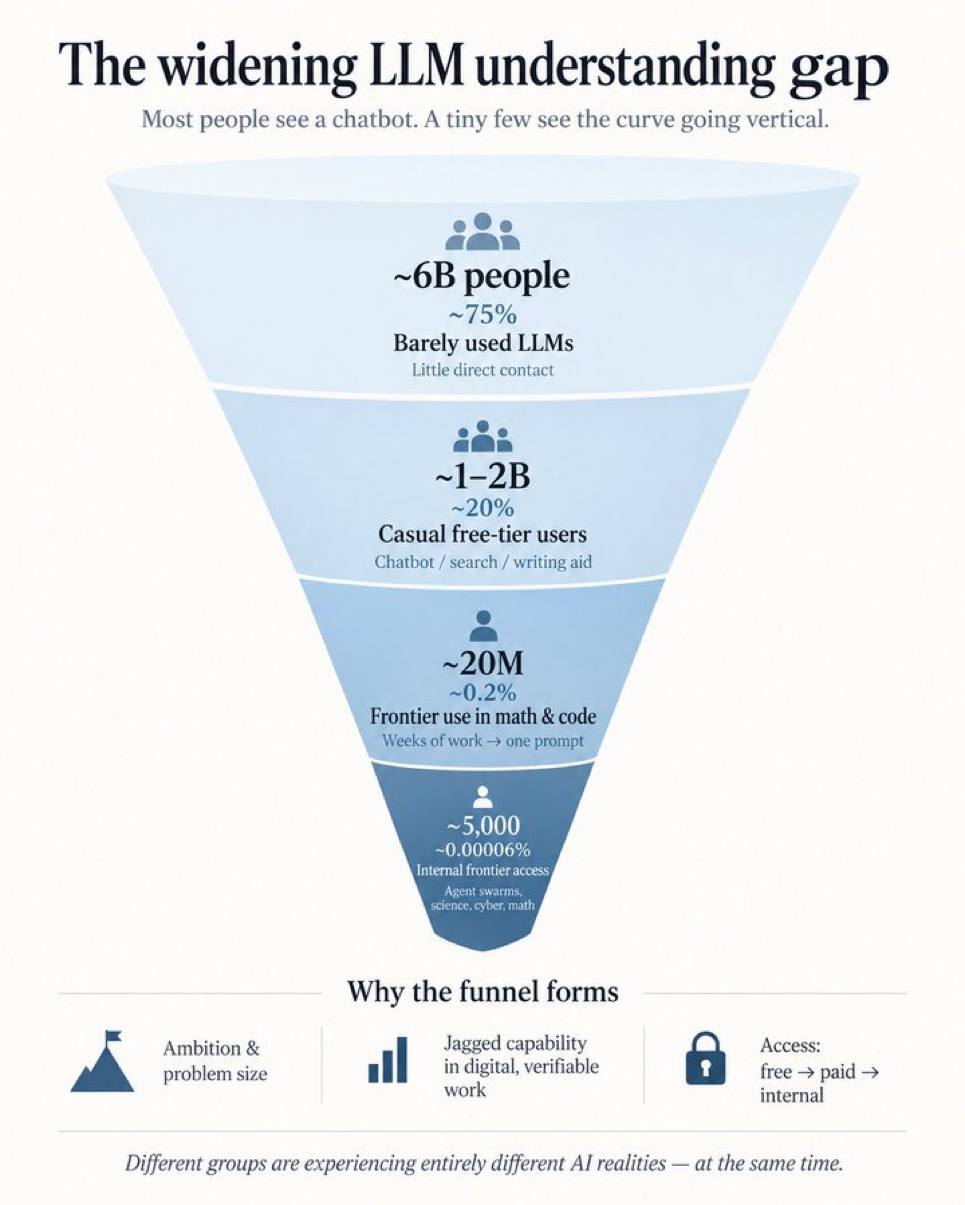
On October 11, 2026, Andrej Karpathy returned on X to a post he had published in April. The gap in understanding the capabilities of large language models, he says, is not narrowing but growing: instead of "two groups of people talking past each other," the result is a sharp funnel. He calls the figures a back-of-the-envelope estimate: about 6 billion people, roughly 75% of the population, have barely encountered LLMs, and another 1–2 billion, about 20%, occasionally use free chatbots like ChatGPT and see them as an improved search or a writing assistant. He puts many professionals outside math and code in the same category, for example executives.
From twenty million to five thousand
Frontier models in math and code are used professionally by roughly 20 million people, 0.2%. They see with their own eyes that complex projects that used to take weeks and months are carried out by agents from a single prompt: they build applications, translate and decompile them from binaries. Less than a year ago, Karpathy notes, he wrote code by hand.
Access to frontier systems from the inside is held by about 5,000 people, around 0.00006%. To the outside world, he says, only previews have been shown, and it looks like this: thousands of agents work together for weeks on large software projects, create zero-day vulnerabilities, conduct cyberattacks and defense at machine speeds, and advance science and math. Human verification is starting to lag: mathematicians may still be poring over 722 manuscripts on frontier mathematics for a while, and the analysis of the old OpenAI-HF incident continues.
Three factors of the funnel
The reasons, in Karpathy's view, are three. Returns grow with the ambition of the task and its horizon: a system offers almost no resistance to a one-paragraph question. Capabilities are uneven, with peaks where the domain is digital, verifiable and economically valuable, because the model is trained with reinforcement learning on verifiable rewards in an environment chosen for commercial potential. And access: free, paid, internal.
He sums it up this way: the public has mostly not encountered these systems, and when it has, it saw a clumsy chatbot; most professionals get a modest gain, and only a small part experiences dizziness from the curve going up. All of this is happening at the same time.
Translation editor: Салтанов А.
Source: x.com ↗